An independent AI cloud rarely owns the whole chain behind its next deployment. The site belongs to one business, the power to a network, the equipment to a vendor, the money to a lender, the build to a contractor. That is what a decentralised buildout means in practice: independent businesses, each under its own contract, that have to arrive in the same place at roughly the same time.
The GPU order is the part of that project everyone can picture. It is also the part that arrives most reliably. The parts that fail are the ones around it: the data centre that is not yet switched on, the installation partner whose schedule slips a quarter, the funding that is available in principle and conditional in practice. A project is not a shipment of accelerators. It is four things arriving at once, and each runs on its own clock.
01
The equipment clock
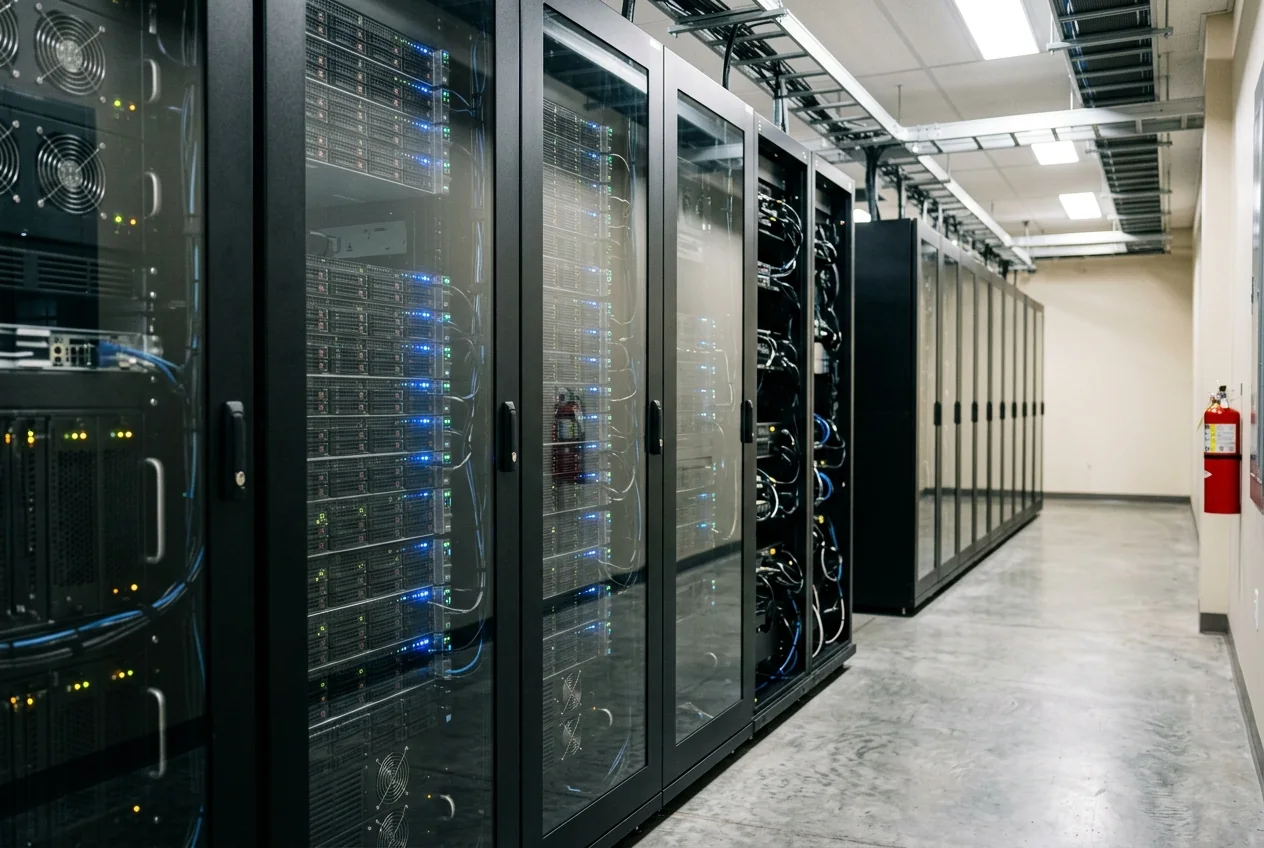
Rack-scale AI systems have changed what a building has to be. NVIDIA's GB200 NVL72 draws in the region of 120 to 130 kW per rack, and the GB300 NVL72 that followed sits higher again, with liquid cooling to the chip as a requirement rather than an option1. The company's Kyber rack, built for the Rubin Ultra generation expected in 2027, is designed around 600 kW per rack and an 800 volt DC power architecture2. A hall specified for the densities of 2023 cannot host that equipment without rebuilding its power chain.
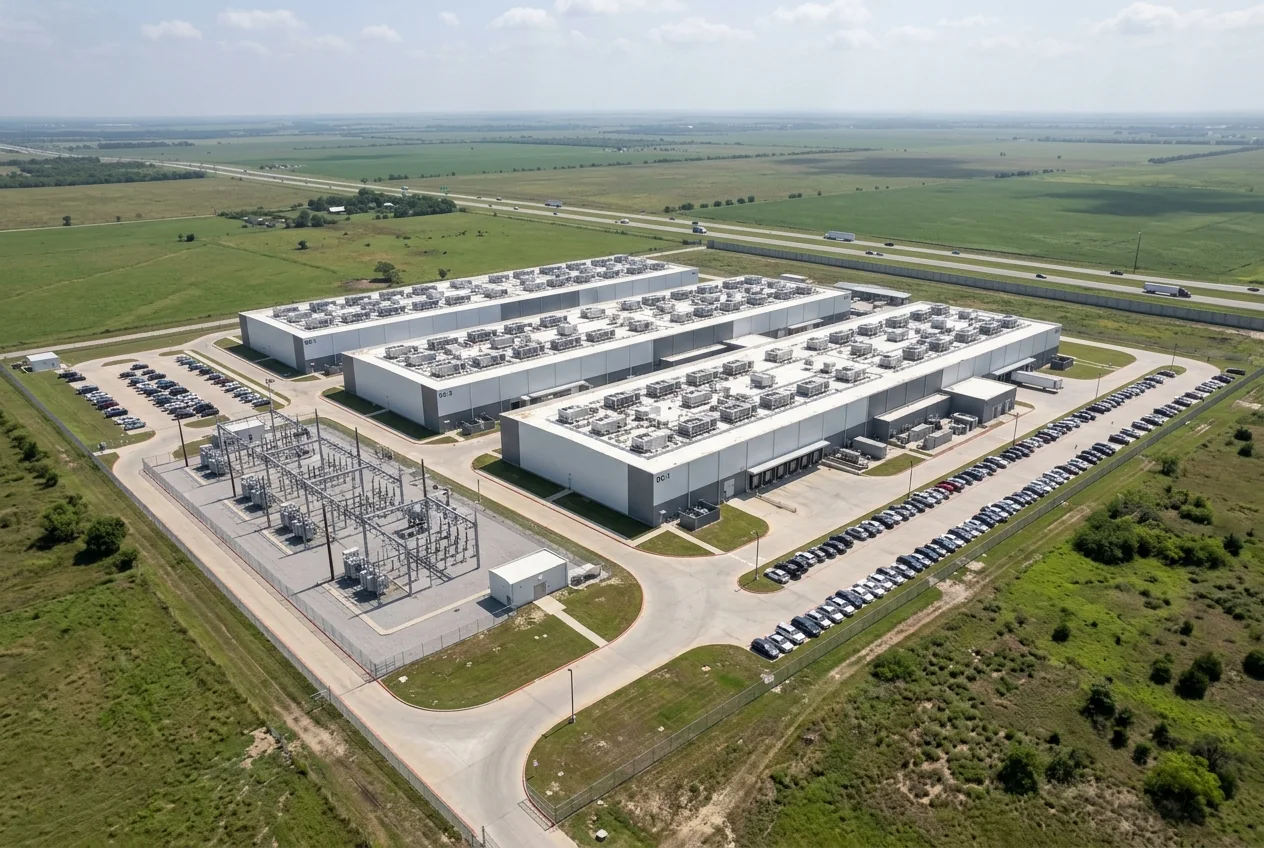
The consequence for a deployment is simple. The equipment arrives on the vendor's timetable, measured in months. The facility it needs is measured in years. Whichever party ordered the racks is now holding depreciating assets against a building that is not ready, or a ready building against racks that have not shipped.
02
The power clock
Data centres consumed about 415 TWh of electricity in 2024, roughly 1.5 percent of global demand, and the International Energy Agency's base case has that more than doubling to around 945 TWh by 20303. In the United States, the Lawrence Berkeley National Laboratory put data centres at 4.4 percent of national electricity in 2023 and projected between 6.7 and 12 percent by 20284. In Ireland, data centres took 22 percent of all metered electricity in 20245. Dominion Energy, the utility for northern Virginia, said in late 2025 that it was in various stages of contracting to supply 47 GW to data centres6.
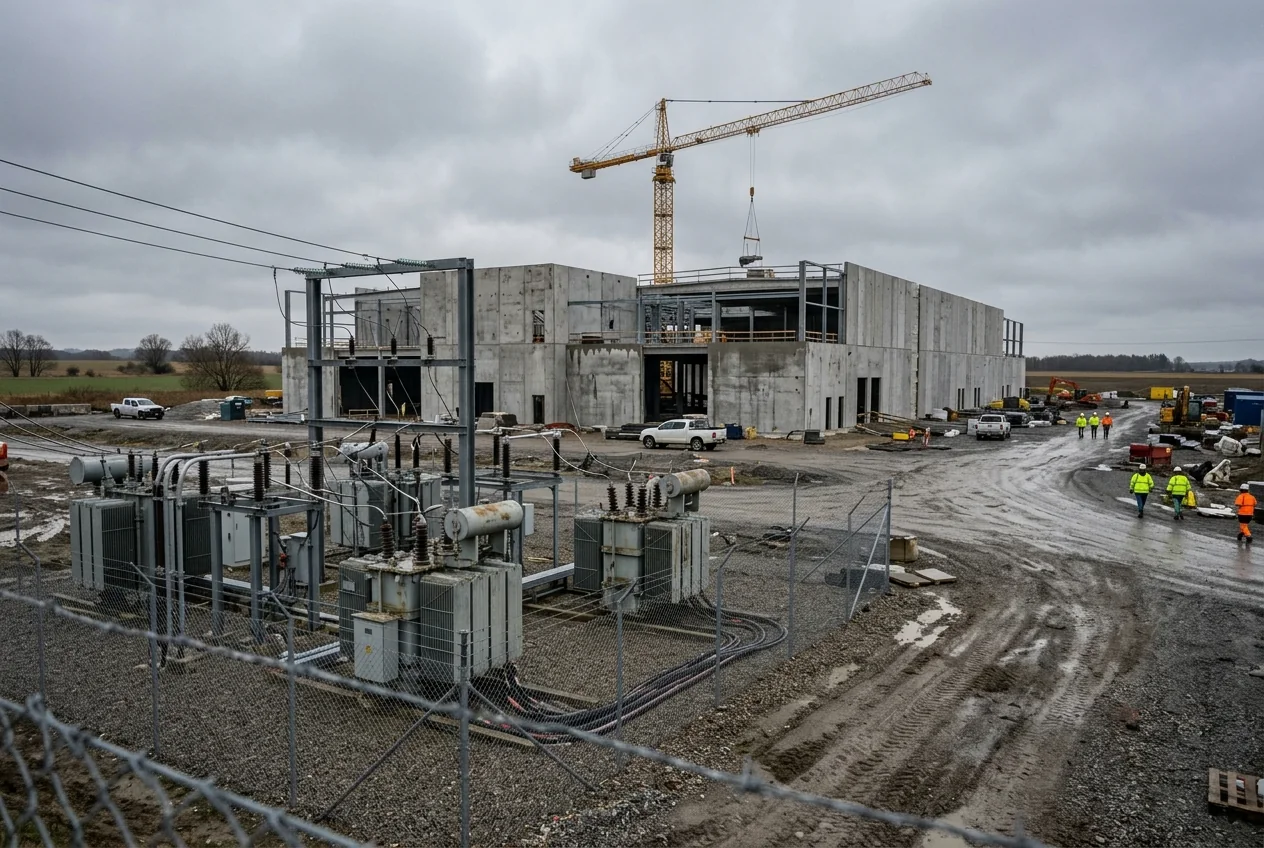
None of that demand connects quickly. LBNL's tracking of US interconnection queues for generation and storage projects finds the median project taking around five years from request to commercial operation, with more than 2,000 GW waiting7. Those are generation queues, not a measured wait for a data-centre load connection, but they show how congested the connection process has become. Large power transformers, the one component a substation cannot do without, carried average lead times of about 120 weeks in 2024, up from around 50 weeks in 20218. In the Uptime Institute's 2025 survey of more than 800 operators, power availability had risen to sit alongside cost as a leading constraint on new capacity9.
For a project, the number that matters is not the site's nameplate. Four different quantities are routinely added together: the connection offer (what the network has offered to connect), the authorised import limit (the most the site may actually draw), permission to energise each stage (when equipment may be switched on) and each customer's IT power allocation (the share of that limit reserved for one customer). Projects get oversold when they are treated as one number.
Projects get oversold when four different power numbers are added together.
03
The funding clock
Morgan Stanley estimates about 2.9 trillion dollars of data centre capital expenditure through 2028, of which roughly 1.5 trillion must come from outside the hyperscalers' own cash flows: private credit, corporate bonds, securitised debt and the rest10. That money is not short. It is conditional. Lenders fund against contracted revenue and delivered, operating assets. Securitisation in particular tends to arrive only after construction, once the asset is running and the lease is paying10.
The order of events is the problem. Someone pays for the equipment before anyone independent can check what the completed system delivers. The lender wants to see delivery before it advances funds; the vendor wants payment before it ships; the installation partner wants a funded order before it mobilises. Each party's condition sits on another party's timeline.
04
The delivery clock
Installation, commissioning and handover have their own calendar, and the word delivered means something different to everyone at the table. To the operator it is racks powered and reachable. To the customer it is capacity that runs its workload at the contracted performance. To a lender it is the condition that releases funding. To an insurer it is the moment risk transfers. If those four definitions are never written down against each other, the project reaches a point where everyone believes something has happened and nobody can act on it.
05
What fitting together looks like
A project that works is one where the four clocks have been made to read against a single set of delivery requirements, written before equipment is ordered, that the customer, the lender, the lead contractor and the operator can all read. Power approvals are kept distinct. Each customer's block keeps its own scope. The moment of delivery is defined in advance, and when it arrives, something independent of the parties says whether what arrived matches what was agreed.
That is the world CANUS works in: putting the project together, coordinating the partners and independently checking what is delivered. The fit is the hard part. The GPUs were never the project.
Sources
- 1
NVIDIA, GB300 NVL72 product page.
www.nvidia.com/en-us/data-center/gb300-nvl72/ - 2
Data Center Dynamics, "Nvidia's Rubin Ultra NVL576 rack expected to be 600kW, coming second half of 2027" (2025).
www.datacenterdynamics.com/en/news/nvidias-rubin-ultra-nvl576-rack-expected-to-be-600kw-coming-second-half-of-2027/ - 3
International Energy Agency, Energy and AI, executive summary (April 2025).
www.iea.org/reports/energy-and-ai/executive-summary - 4
Lawrence Berkeley National Laboratory, 2024 United States Data Center Energy Usage Report (December 2024).
eta-publications.lbl.gov/sites/default/files/2024-12/lbnl-2024-united-states-data-center-energy-usage-report.pdf - 5
Central Statistics Office, Ireland, Data Centres Metered Electricity Consumption 2024.
www.cso.ie/en/releasesandpublications/ep/p-dcmec/datacentresmeteredelectricityconsumption2024/ - 6
Reuters, "Dominion Energy beats estimates on strong power demand in Virginia, South Carolina" (31 October 2025).
www.reuters.com/business/energy/dominion-energy-beats-estimates-strong-power-demand-virginia-south-carolina-2025-10-31/ - 7
Lawrence Berkeley National Laboratory, Queued Up: Characteristics of Power Plants Seeking Transmission Interconnection (annual editions).
emp.lbl.gov/queues - 8
Wood Mackenzie, "Supply shortages and an inflexible market give rise to high power transformer lead times" (2024).
www.woodmac.com/news/opinion/supply-shortages-and-an-inflexible-market-give-rise-to-high-power-transformer-lead-times/ - 9
Uptime Institute, 15th Annual Global Data Center Survey (July 2025).
uptimeinstitute.com/about-ui/press-releases/uptimes-15th-annual-global-data-center-survey-results-shows-both-commitment-and-hesitancy - 10
Morgan Stanley Research, "Bridging the Data Center Financing Gap" (2025).
www.morganstanley.com/content/dam/msdotcom/en/assets/pdfs/Research_Bridging-Data-Center-Gap.pdf
Public sources, cited as read at the time of writing. CANUS is not affiliated with any company named in these articles, and none of the transactions described involved CANUS.